How Much Practice Does a Young Cricketer Actually Need Per Week?

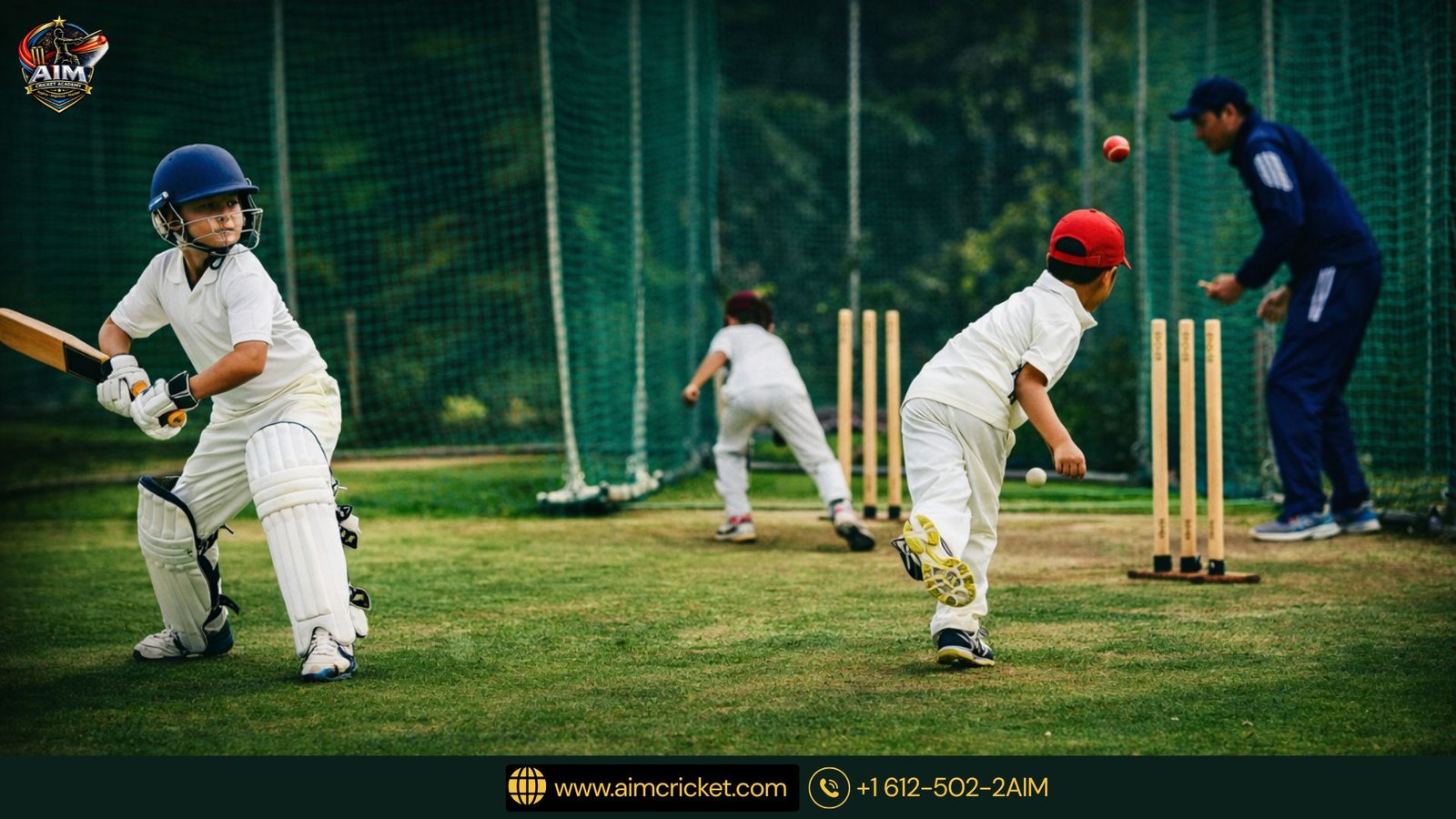
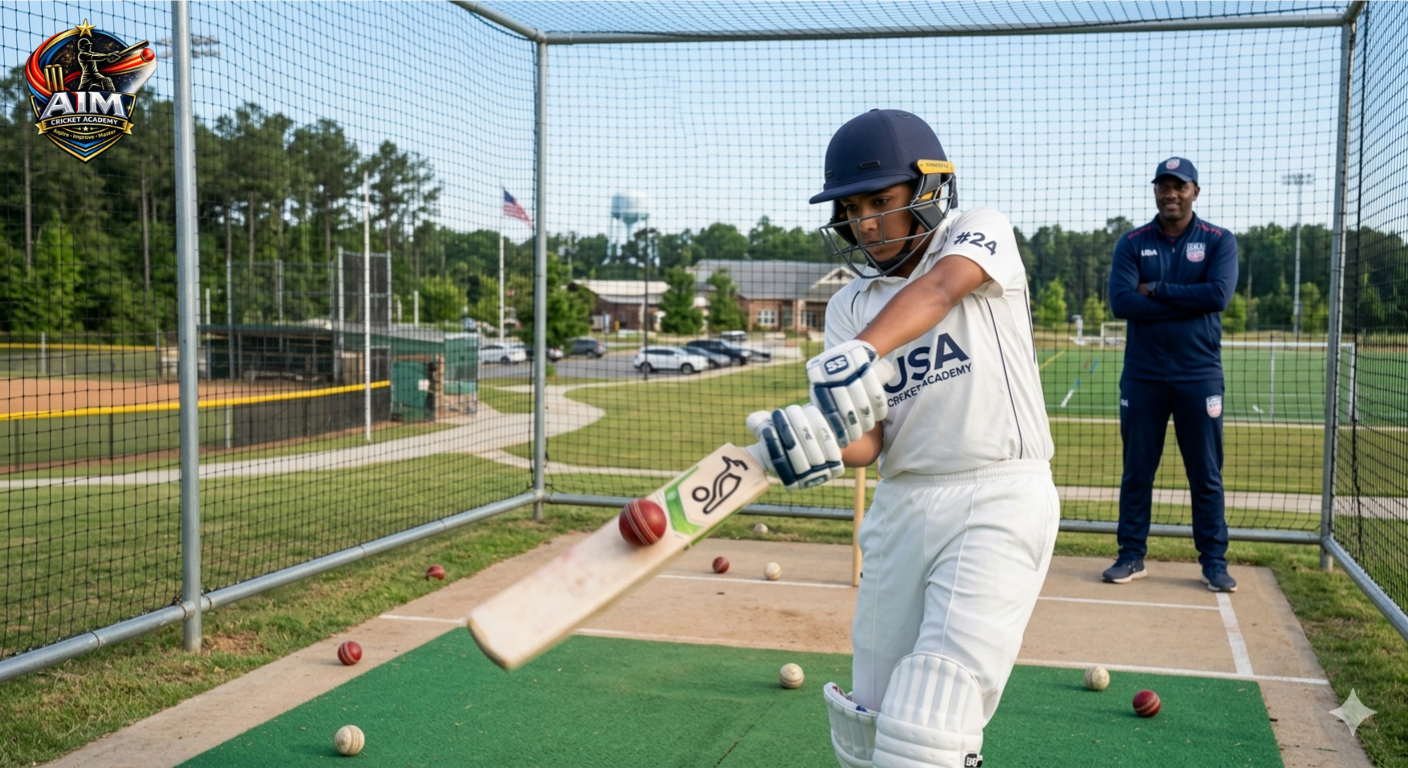
Young cricketer practicing batting in nets with coach at AIM Cricket Academy training session

The journey from a backyard enthusiast to a confident player on the pitch is an exciting one, but it often leaves parents and young athletes with a burning question: How much is too much? In the world of youth sports, there is a fine line between building mastery and risking burnout.

Cricket is a sport of high technicality and physical endurance. Finding the “sweet spot” for practice depends largely on the child’s developmental stage, their physical maturity, and their long-term goals. Here is a breakdown of how to structure a young cricketer’s week to ensure they stay sharp, healthy, and most importantly, in love with the game.

The Foundation: Quality Over Quantity

In the early stages, the goal isn’t to log 20 hours a week in the nets. Instead, the focus should be on “deliberate practice.” This means every session has a specific purpose, whether it’s refining a defensive stroke or perfecting a bowling run-up. For children, excessive repetition can lead to overuse injuries, particularly for young fast bowlers whose bones are still developing.

A balanced weekly schedule should include a mix of technical drills, match-play scenarios, and general athletic development (like agility and strength training).

Development Stages and Weekly Hours

To help categorize practice needs, we look at developmental tiers that align with age and skill level.

AIM Basics (Age 7+, All Genders): 

At this entry level, the focus is purely on engagement and fundamental movement. Practice should occur 1 to 2 times per week, lasting about 60 to 90 minutes per session. The objective is to develop hand-eye coordination and basic game understanding through fun, high-energy drills.

AIM Development (Age 7+, All Genders & Performance): 

As players move into this tier, they begin to transition from “learning to play” to “playing to compete.” A recommended schedule is 2 to 3 sessions per week. This allows for one session dedicated to specialized coaching (batting or bowling techniques) and another for team-based match simulations.

AIM Performance (Age 8+, All Genders): 

For those showing a higher level of commitment and talent, the intensity increases slightly. 3 to 4 sessions per week is standard. At this stage, players should also incorporate “active recovery” days where they focus on mobility and watching professional matches to improve their tactical IQ.

Avoiding the Burnout Trap

It is vital to remember that young athletes need at least two full days off from organized sports per week. These rest days allow the body to repair tissues and the mind to reset. Over-training often manifests as a drop in performance, irritability, or recurring “niggles” in the back or shoulders.

The best way to measure if the volume is right is to monitor the child’s enthusiasm. If they are eager to grab their kit bag, the balance is likely correct. If it starts feeling like a chore, it’s time to scale back and prioritize the joy of the sport.

Elevate Your Game with AIM Cricket Academy

Finding the right balance requires expert guidance and a structured environment that puts the player’s health first. At AIM Cricket Academy, we specialize in nurturing talent through our tiered programs: AIM Basics, AIM Development, and AIM Performance. Whether your child is just picking up a bat for the first time at age 7 or is an aspiring 8-year-old athlete ready for high-performance training, our academy provides a safe, professional, and inclusive space for all genders. We combine elite-level coaching with a focus on long-term athletic development, ensuring every young cricketer has the tools to succeed on and off the field. Join AIM Cricket Academy today and watch your child’s passion for the game reach new heights.
Youth Cricket Coaching Twin Cities

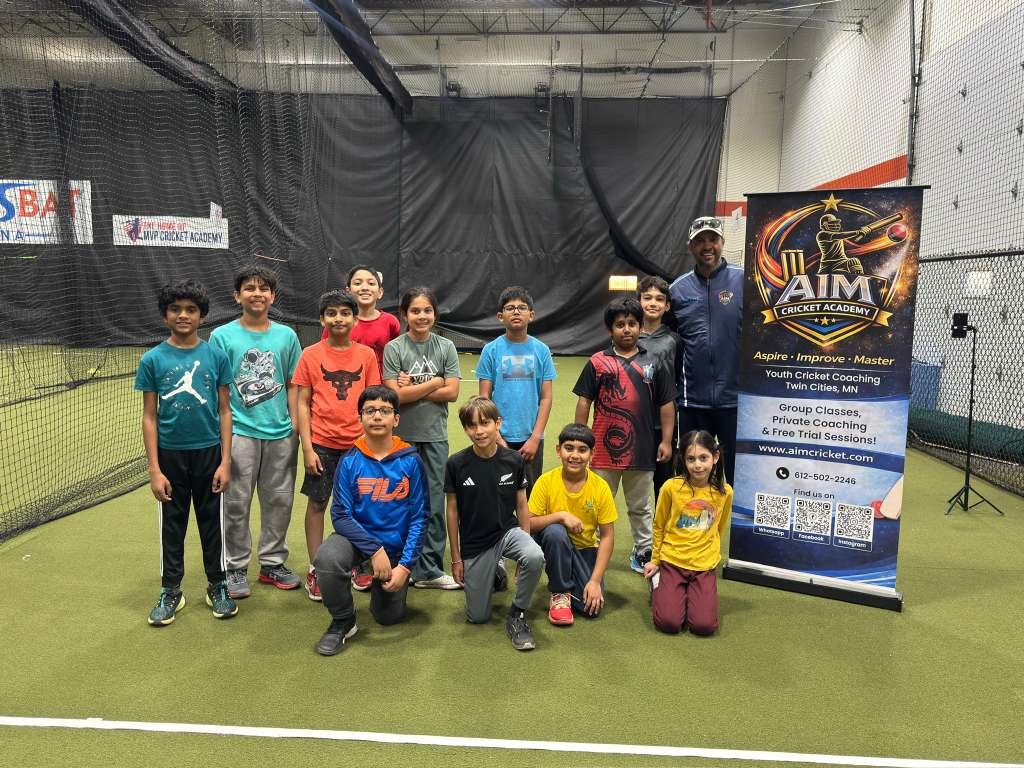
Group of young cricketers with coach at AIM Cricket Academy indoor training facility

AIM Cricket Academy provides professional youth cricket coaching in the Twin Cities, helping young players build strong fundamentals and confidence.

Whether your child is just starting or looking to compete, we provide a clear development pathway.


Designed for Kids of All Skill Levels

We work with:

  • Beginners (no prior experience)
  • Intermediate players
  • Competitive youth cricketers

Our structured approach ensures every child improves at their own pace.


What Makes AIM Different?

Most programs focus on playing.

We focus on development first.

✔ Structured training sessions
✔ Measurable skill progress
✔ Strong coach-player connection
✔ Positive and disciplined environment


Building More Than Just Skills

At AIM, kids learn:

  • Teamwork
  • Discipline
  • Confidence
  • Love for the game

Convenient Location in Twin Cities

We train players from:

  • Apple Valley
  • Bloomington
  • Burnsville
  • Chaska
  • Eagan
  • Eden Prairie
  • Lakeville
  • Plymouth
  • Prior Lake
  • Savage
  • Shakopee
  • Woodbury
  • Minneapolis
  • Surrounding areas

Join Today

Looking for youth cricket training near you in the Twin Cities?

👉 Book a free trial session today

Beyond the Boundary: Your Guide to College Cricket Scholarships and University Leagues

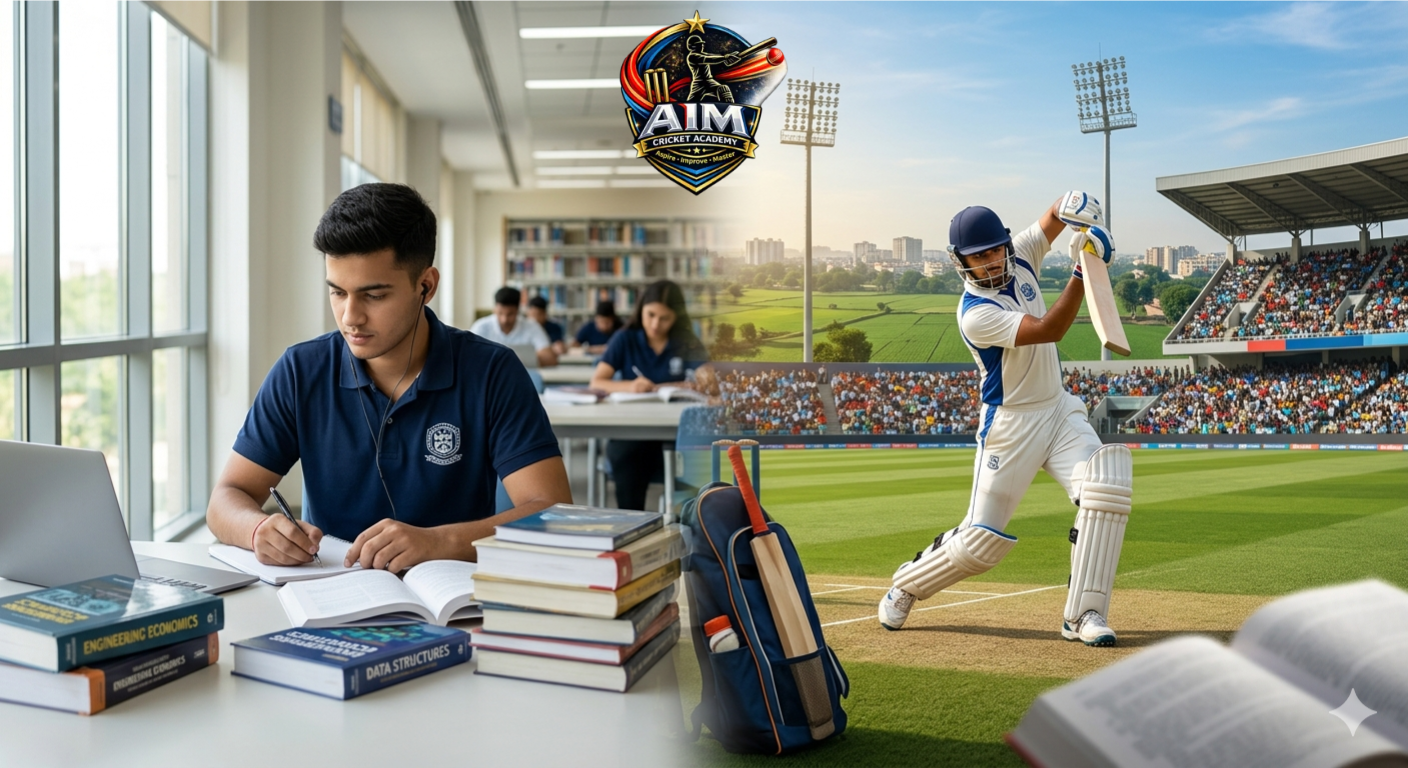
Student studying with books and laptop alongside young cricketer playing in stadium representing balance of academics and sports

For years, the future for a promising young cricket player in America was capped at the end of his high school career. Due to the lack of a proper college system, many players retired from the sport to concentrate on their studies. But the “American Cricket Revolution” has finally hit the college campuses. You can now rely on your cover drive or outswinger to pay for your tuition fees.

The emergence of MLC and the T20 World Cup scheduled to take place in the US in 2024 has led to an increased demand for college-level leagues. If you are a player who wants to play cricket while earning his degree, there is no better time than now.

The Infrastructure: NCAA and American College Cricket

Two main associations lead the university cricket scene in the US: American College Cricket (ACC), and the National Collegiate Cricket Association (NCCA).

These two associations have changed “club sports” into very competitive leagues where success is highly valued. The ACC, for example, has developed from just a few teams to more than 70 universities playing cricket. These teams compete in regional competitions and a National Championship that usually gets televised across the nation.

The NCCA is no different in its approach to the game, collaborating with groups such as the Seattle Orcas (MLC). The result of these collaborations provides students an opportunity to showcase their skills and gain entry into the Minor or Major leagues.

The Reality of Cricket Scholarships

Cricket, unlike football or basketball, is not one of the main NCAA sports, so there aren’t any “Full Ride” scholarships for cricket in every big university. But times are changing, and we may see a combination of both soon.

1. Dedicated Athletic Scholarships

A select number of organizations have begun offering athletic scholarships for players of cricket as well. This includes Haverford College, which boasts of having the oldest cricket team in the United States. In addition, other institutions located in Texas and Florida have adopted this practice as well.

2. University-Specific Grants

Most colleges provide “Club Sport Scholarships.” For example, when you join universities with an overwhelmingly strong cricket team such as University of South Florida (USF) and UT Dallas, the sports department is bound to offer financial assistance so that the talented ones can cover costs of training, transport, and academic fees.

3. Institutional Diversity Scholarships

Cricket is a worldwide sport, so many American colleges capitalize on their cricket team by recruiting more students internationally. You might be considered for scholarships based on your academic merit or diversity as a foreign athlete or if you come from one of America’s best cricket academies.

How to Get Noticed by Recruiters

Getting onto an elite university team takes more than being good; it needs a plan of action.

  • Create an Online Portfolio: You cannot hope that recruiters will always be in every local park. Video record your nets, matches, and game highlights. Make use of high performance video analysis to showcase your skill level.
  • Compete in Sanctioned Tournaments: The best way to have your statistics recorded in the database is through playing in either USAC sanctioned youth tournaments or high performance academy leagues.
  • Contact the Club Presidents: College clubs are run by students but advised by professors. Look up the contact details of the club president via their LinkedIn profile or through the college database towards the end of your junior year of high school.

The “Professional” Student-Athlete

With the increasing importance of the university system, this is not just playing around anymore. It is playing with your reputation. The MLC teams are starting to look at college players as possible candidates for “Domestic” players.

It is advantageous to play for an elite school since you get to use world-class training facilities, trainers, and fellow players who have similar career objectives like yourself.

Turning Passion into a Degree

Attending a particular college can change your life. When looking for colleges with a good cricket program, you don’t have to decide whether you want to hold onto your bat or open a book; you can major in engineering, business, or anything else and play in front of national scouts.

The university level league system in the USA is not a myth anymore, but an established fact. If you are talented enough, the next fence you jump over may very well be that at the college where you will earn money by playing cricket.

Youth Cricket Coaching in Minnesota

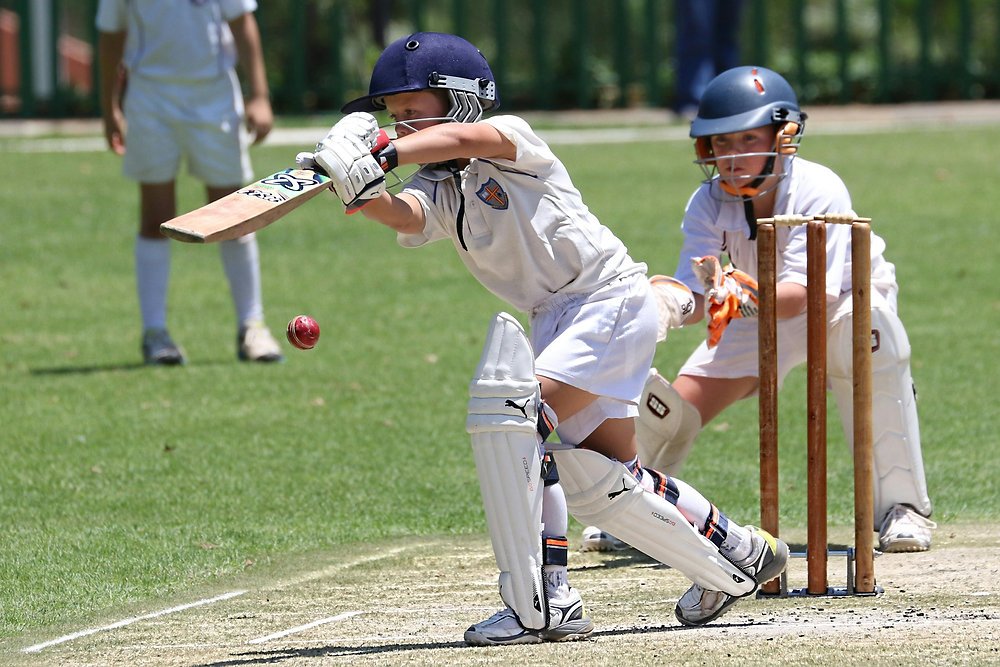
Young cricketer playing a front foot shot during a match with wicketkeeper behind the stumps

If you’re searching for youth cricket coaching in Minnesota, AIM Cricket Academy offers one of the most structured and results-driven youth cricket programs in the Twin Cities.

We focus on building strong fundamentals, confidence, and game awareness—helping kids grow from beginners to competitive players.

Why Choose AIM Cricket Academy?

At AIM, we don’t just run sessions—we build players.

✔ Structured coaching curriculum
✔ Age-appropriate training (7+)
✔ Skill-based progression system
✔ Focus on technique, fitness, and mindset
✔ Regular feedback for parents
✔ Goal tracking

Our goal is simple: real improvement, not just participation.

Programs We Offer

🏏 AIM Basics
Perfect for beginners starting their cricket journey. Focus on:

Batting & bowling fundamentals
Basic fielding skills
Hand-eye coordination

🏏 AIM Development
For players who know the basics and want consistency:

Shot selection
Bowling control
Game awareness

🏏 AIM Performance
Advanced training for competitive players:

Match scenarios
Strategy & decision-making
Performance tracking

🏏 U11 | U13 | U15
For players ready to apply their skills in structured match environments.

Competition, teamwork, and real-game experience

1 on 1 Private Sessions
For players seeking focused attention to accelerate batting or bowling improvement.

Targeted private coaching designed to fast-track measurable improvement.

Location – Twin Cities, Minnesota

Our sessions are conducted in the Twin Cities area (Burnsville) with indoor facilities, making training consistent year-round.

Book a Free Trial

We offer a free trial session so your child can experience our coaching before enrolling.

👉 Limited spots available
👉 Small group sizes for better attention

Start Your Child’s Cricket Journey Today

If you’re looking for youth cricket coaching in Minnesota, AIM Cricket Academy is the perfect place to start.

👉 Register now or book a free trial today

Why cricket is growing faster than ever in the United States

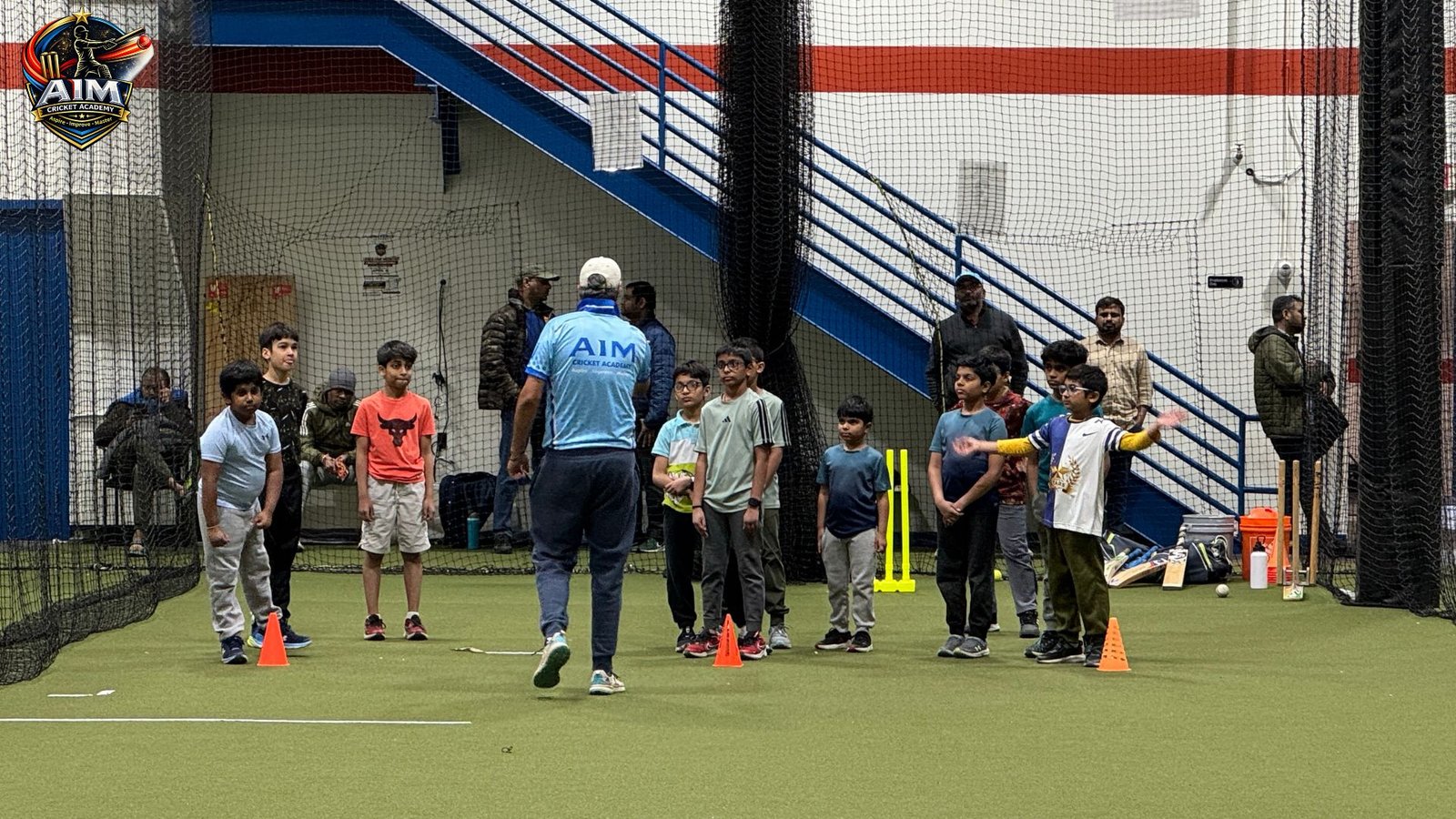
Cricket coach instructing group of young players during indoor training session with cones and drills

Walk into a park in Frisco, Texas on a Saturday morning and you’ll find multiple cricket matches running at the same time. Drive through the suburbs of New Jersey, Northern Virginia, or the Twin Cities and you’ll spot makeshift pitches on school fields — families setting up stumps, kids in whites, someone’s dad doing an animated impression of a spin bowler. Cricket has arrived in America. It just didn’t announce itself very loudly.

The growth has been quiet but relentless. In 2024, the United States co-hosted the ICC Men’s T20 World Cup — the first time a global cricket event of that scale was held on American soil. The games sold out. The venues surprised everyone. And for millions of first and second-generation immigrants who grew up with the sport, it felt like long overdue recognition of something they had quietly kept alive for years.

A diaspora that never stopped playing

Cricket’s roots in America run deeper than most people credit. Indian, Pakistani, Sri Lankan, Bangladeshi, and West Indian communities have been playing organized cricket in the US for decades — in backyards, community grounds, and club leagues that rarely made the news but never stopped running. According to USA Cricket, there are now over 200,000 registered players in the country, and that number doesn’t account for the far larger number playing informally. By the time the mainstream started paying attention, these communities had already built the foundation: the coaches, the culture, and the kids who grew up watching the sport at home and wanting to play it themselves.

“The T20 World Cup didn’t create cricket in America. It made the rest of the country look up and notice what was already there.”

T20 changed everything for new audiences

One of cricket’s biggest barriers in the American market has always been time. A Test match runs five days. Even a One Day International is an eight-hour commitment. T20 cricket broke that barrier completely. A match lasts around three hours, moves fast, and delivers the kind of big moments that American sports fans respond to. Viewership numbers from the 2024 World Cup surprised broadcasters. Interest in youth programs spiked in every city that hosted matches. Cricket had finally found its American format.

Youth participation is the real story

The most meaningful shift isn’t happening at the professional level — it’s happening in academies and youth leagues across the country. Second-generation South Asian kids who grew up watching IPL with their families are now asking to play the game, not just watch it. Parents who never played cricket are signing their children up for structured coaching because they see what the sport develops — patience, tactical thinking, hand-eye coordination, and a kind of quiet discipline that transfers well beyond the pitch.

This is the generation that will determine whether cricket in America stays a community sport or becomes genuinely mainstream. The waitlists at youth academies, the growth in club registrations, and the number of kids picking up a bat for the first time all point in the same direction.

Infrastructure is finally catching up

For years, the lack of proper facilities was a genuine constraint on growth. Indoor cricket centers have now opened in multiple cities. Purpose-built turf lanes are available in states where a batting net was nearly impossible to find a decade ago. USA Cricket has invested in a national junior pathway, and several states now have representative programs that give talented young players a route to higher competition. The sport still has ground to cover before it challenges baseball or soccer for youth participation at a national scale — but the trajectory is real, the interest is genuine, and the communities building it have been patient enough to do it properly.

If you’re in the Twin Cities and want your child to be part of this wave, AIM Cricket Academy is Minnesota’s dedicated cricket coaching program for young players aged 7 and up. With skill-based programs, age-group squads from U11 to U15, and private lessons across multiple suburbs — from Burnsville to Eden Prairie — AIM is where the next generation of Twin Cities cricketers is getting started.

What to Expect in Your Child’s First Cricket Class

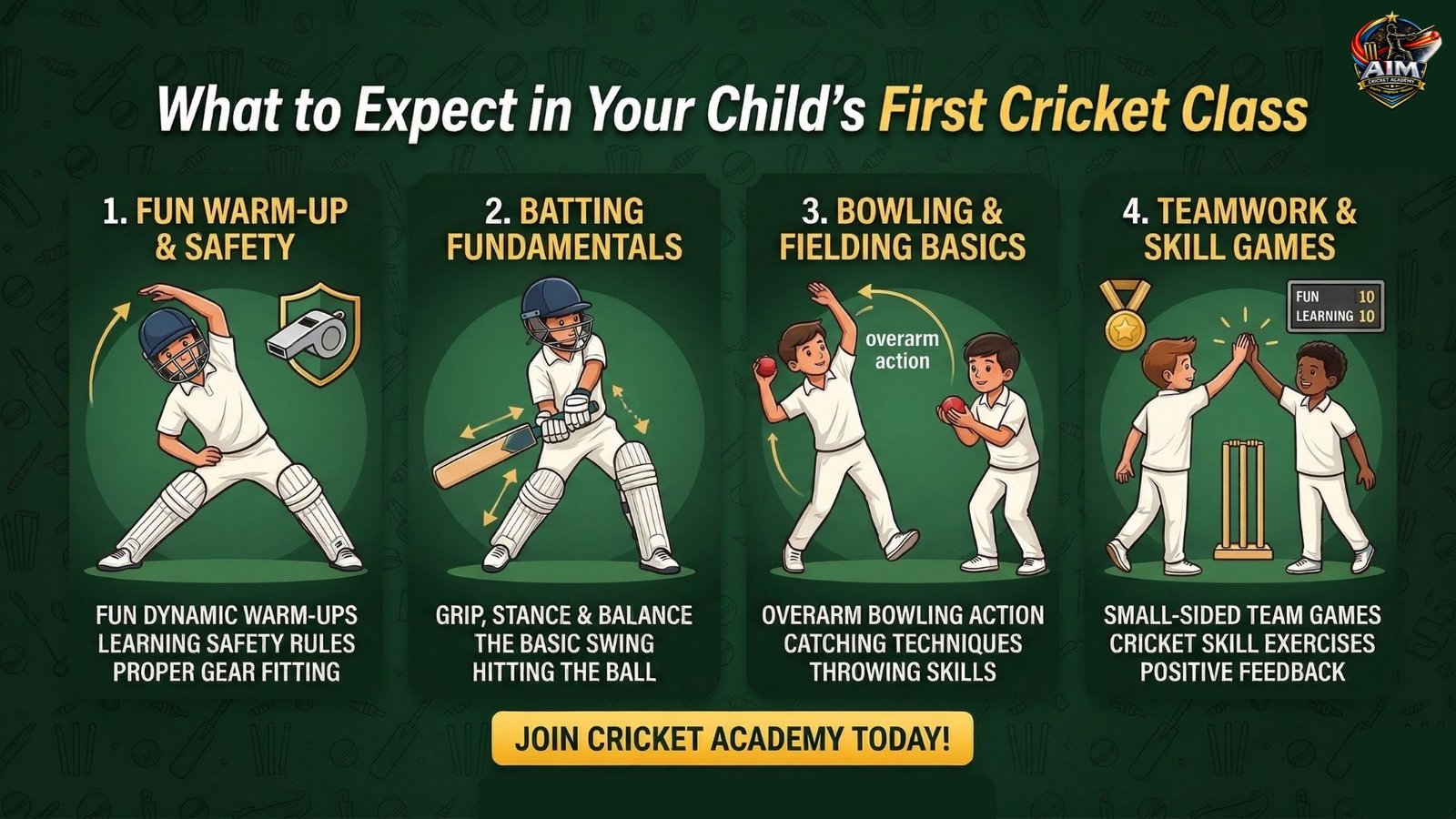
Infographic showing what to expect in a child’s first cricket class including warm-up, batting, bowling, and teamwork activities

The registration is done. The free trial is booked. And now you’re standing outside the facility, your seven-year-old beside you, both of you equally unsure of what’s about to happen.

That feeling is completely normal. Cricket isn’t a sport most American schools introduce kids to, and for many families in the Twin Cities, even those who grew up watching it back home, there’s something nerve-wracking about watching your child step into it for the first time.

This is a specific, honest look at what actually happens in a first class at AIM, and what to do, and not do,as the parent on the sideline.

Before You Walk In

Come a few minutes early. Not because you’ll miss anything critical, but because rushing in with thirty seconds to spare sets a flustered tone for a child already processing something new.

Comfortable clothes and sports shoes are all they need. Leave the cricket bat at home — the academy provides everything for the trial, and bringing personal gear before your child has even held a coaching bat adds a small pressure that first sessions don’t need.

What the First 15 Minutes Look Like

Coaches at AIM don’t open with a lecture. The session gets moving quickly because standing around is the fastest way to lose a seven-year-old’s attention.

Expect a warm-up that doesn’t feel like a warm-up, running games, reaction drills, catching challenges. The fitness component is embedded into activities rather than announced as exercise. Young players who are having fun don’t notice they’re working.

Your child may look uncertain in these opening minutes. Watch for the moment they stop watching the other kids and start just doing. It usually comes sooner than parents expect.

What Skills Get Introduced First

First sessions focus on three foundational things regardless of age:

Grip and stance. Before a child ever faces a ball, they learn how to hold a bat and where to stand. These two things, done wrong from the beginning, take months to undo. Coaches spend real time here.

Catching and throwing. Hand-eye coordination is the engine of cricket. Basic catching drills, starting close, building distance, are immediately fun because success is quick and visible.

Facing a soft ball. Nobody bowls at pace in session one. Coaches use soft balls and gentle feeds. The goal isn’t technique yet, it’s simply making the child feel like they can do this.

What the first session is not: a tryout. Nobody is being evaluated for a squad.

What to Do as a Parent During the Session

Watch from a respectful distance. Children perform differently when they feel observed versus when they feel free to try and fail.

Resist coaching from the sideline. Even if you play cricket seriously, stay quiet. Your child has a coach. The moment they’re processing two sets of instructions simultaneously, neither one lands.

On the drive home, ask good questions: not “were you the best?” but “what was the hardest part?” or “did you like the catching drills?” These open a conversation rather than put a child under pressure to deliver a verdict.

What Your Child Might Say Afterward

Some kids climb into the car buzzing, already asking when the next session is. Others are quiet, still absorbing it.

A child who says “it was okay” after their first cricket class is not telling you it was a failure. They’re telling you it was new. New things feel like “okay” until they become familiar — and familiar things, done consistently, become the ones they love.

The only real red flag is active distress that goes beyond shyness or tiredness. Everything else is normal first-day noise.

That transformation starts in the first class. It just doesn’t look like transformation yet, it looks like a kid nervously picking up a bat for the first time in a gym in the Twin Cities.

Which is exactly where it should start.

Ready to book your child’s free trial? AIM Cricket Academy runs programs across Apple Valley, Bloomington, Burnsville, Chaska, Eagan, Eden Prairie, Lakeville, Plymouth, Shakopee, and Woodbury.

Best Age to Start Cricket Training

Young cricket player in full gear practicing batting at an AIM Cricket Academy net session with a coach.

Cricket is a game that requires a combination of skill, hand-eye coordination, physical fitness, and mental strength. For parents and potential cricketers, one of the biggest questions is: What is the right age for starting cricket training? Well, it is a general notion that it is not a fixed age, but it varies depending on the physical, cognitive, and motivational factors of a child. Still, it is generally recommended that a child should be in the range of 5 to 12 years, and more specifically, in the range of 9 to 12 for developing skills in the game of cricket.


Why early initiation is important

Starting at the age of 5 to 8 is generally recommended as the right age for initiating a child into cricket. At this stage, a child is developing fundamental motor skills, and it is very important for a child to develop motor skills, as it is a fundamental requirement of a game of cricket.

At this stage of early training, it is not about creating mini-professionals. At this stage, it is about:


  • Introducing rules and techniques in a playful manner.
  • Improving hand-eye coordination.
  • Creating a love for the game and teamwork.

At this stage, it is a period of high brain and neuromuscular plasticity. As a result, kids who begin training at this stage will likely possess more refined movements and quicker decision-making skills on the field.


The golden skill development stage: 9-12 years


At this stage, coaches and sports scientists describe this period as a “golden age of motor learning” for a game of cricket. At this stage, kids can learn game-specific techniques, such as batting, bowling, and fielding, more efficiently than at any other stage of their lives.


Benefits of training this age group:

  • Rapid technique improvements through repetition.
  • Development of muscle memory for batting, bowling, and fielding techniques.
  • Easy adaptation of multi-tasking in a game situation.

For coaches who train this age group, it is about creating a good balance of structured training that is fun, yet not too structured that it kills the passion for the game, nor too unstructured that it affects technique.


Foundation stage: 6–10 years

Many experts divide the “best age” discussion into stages. The 6–10‑year bracket is often called the foundation stage.

At this level, the emphasis should be on:

  • Fun‑based drills (relay games, mini‑matches, target‑hitting).
  • Basic skills: grip, stance, simple shots, under‑arm bowling, catching, and throwing.
  • Safety and flexibility work to prevent injuries.

Parents should avoid pushing for early specialization or over‑training. The goal is to build a solid base so that when the child reaches 11–14 years, they can transition smoothly into more intense, skill‑focused training.


Skill development stage: 11–14 years

From 11 to 14 years, formal cricket training can become more serious. This is typically when children join junior academies, school teams, or district‑level programmes.

At this stage:

  • Players begin to specialize—batsman, bowler, or wicketkeeper.
  • Technical refinement becomes critical: footwork, timing, line‑length consistency, and fielding patterns.
  • Match‑play experience grows through school tournaments, academies, and local leagues.

This age also aligns with major age‑group tournaments such asU-11 U‑13, U‑15, and U‑19 events, which are gateways to higher‑level selections. Early starters from 5–10 years often have a noticeable edge here because their fundamentals are already ingrained.


Competitive and high‑performance stage: 15–17 years

From 15 to 17 years, the focus shifts from learning to performing under pressure. This phase is crucial for players aiming at state‑level representation, club‑cricket exposure, or professional pathways.

Training at this point usually includes:

  • High‑intensity sessions, fitness drills, and video analysis.
  • Mental conditioning, match‑simulation scenarios, and temperament building.
  • Regular participation in competitive tournaments and trials.

Late starters can still excel here, but they need extra dedication to bridge the gap in technique and experience created by beginning after 10–12 years.


Is it ever too late to start?


The question many parents and older individuals ask is, “Is it ever too late if my child/teen starts at 15 or even 18?” The answer is a resounding ‘no’; it is never too late to start cricket training, although it is certainly tougher.


Players who begin their cricket training at a later stage in their lives should:


  • Focus on fitness and flexibility to aid their game.
  • Work on game IQs and specialize in specific areas, such as bowling or finishing.
  • Get exposure in cricket clubs, universities, and local leagues to show their skills.
  • Several amateur and semi-pro players have made successful cricket careers for themselves even after beginning their game in their late teens, only because they practiced hard.


Factors that matter more than the actual age


Although the actual age matters, it is not the only factor. Coaches and experts say that interest, discipline, quality coaching, and training environment are factors that matter more than the actual age.


Non-Age Factors:

  • The consistency of training over time.
  • The quality coaching received.
  • The environment at home, which provides the right balance between studies and cricket.
  • Training in such a way as to avoid injuries by including proper warm-up and cool-down exercises.


A child who starts at 7 but trains only occasionally may be less advanced than another who starts at 10 but trains regularly under a good coach.


Practical tips for parents and coaches

For parents and coaches wondering how to time cricket training, here are some practical guidelines based on current coaching wisdom:

  • Ages 4–6: Introduce cricket through playful games and short sessions (2–3 days a week).
  • Ages 6–10: Enroll in a beginner cricket academy with a focus on fun, basics, and coordination.
  • Ages 9–12: Maximize technical drills and match‑like practice—this is the “golden window.”
  • Ages 11–14: Add formal coaching, tournaments, and a bit more structure.
  • Ages 15+: Balance intensity with injury prevention, and focus on performance and mindset.

Allowing the child some autonomy in choosing their role (batting, bowling, or all‑round) at an early age also helps in long‑term retention and enjoyment of the sport.


Conclusion

While the appropriate age for cricket training is between 5 and 12 years, success is achieved through appropriate coaching, consistency, and environment. At AIM Cricket Academy, we offer professional coaching for youth cricket, training, and facilities. Our academy is committed to providing appropriate coaching for children who wish to learn cricket from scratch and for those who wish to achieve advanced performance.