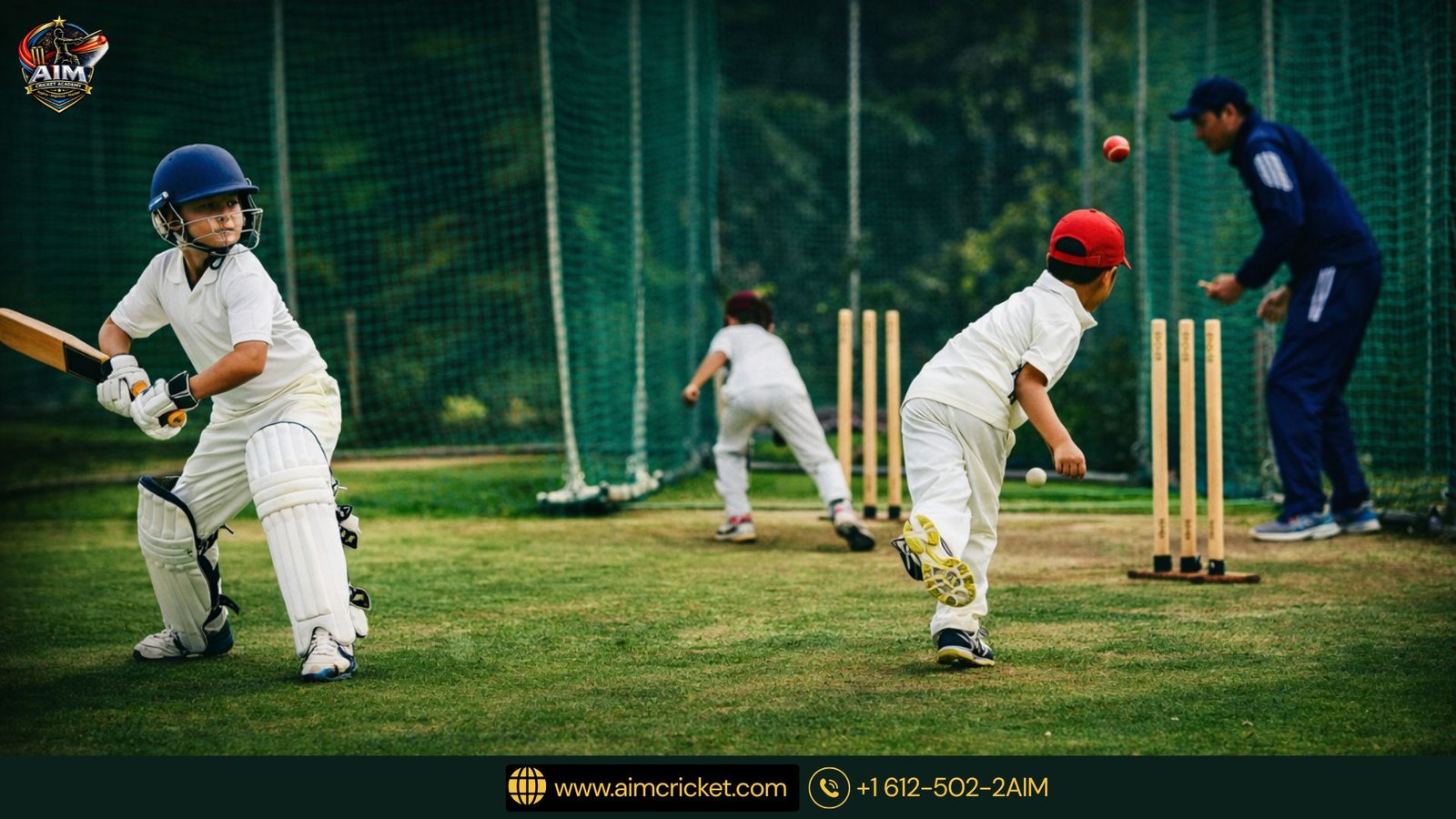
Cricket is a game that requires a combination of skill, hand-eye coordination, physical fitness, and mental strength. For parents and potential cricketers, one of the biggest questions is: What is the right age for starting cricket training? Well, it is a general notion that it is not a fixed age, but it varies depending on the physical, cognitive, and motivational factors of a child. Still, it is generally recommended that a child should be in the range of 5 to 12 years, and more specifically, in the range of 9 to 12 for developing skills in the game of cricket.
Why early initiation is important
Starting at the age of 5 to 8 is generally recommended as the right age for initiating a child into cricket. At this stage, a child is developing fundamental motor skills, and it is very important for a child to develop motor skills, as it is a fundamental requirement of a game of cricket.
At this stage of early training, it is not about creating mini-professionals. At this stage, it is about:
- Introducing rules and techniques in a playful manner.
- Improving hand-eye coordination.
- Creating a love for the game and teamwork.
At this stage, it is a period of high brain and neuromuscular plasticity. As a result, kids who begin training at this stage will likely possess more refined movements and quicker decision-making skills on the field.
The golden skill development stage: 9-12 years
At this stage, coaches and sports scientists describe this period as a “golden age of motor learning” for a game of cricket. At this stage, kids can learn game-specific techniques, such as batting, bowling, and fielding, more efficiently than at any other stage of their lives.
Benefits of training this age group:
- Rapid technique improvements through repetition.
- Development of muscle memory for batting, bowling, and fielding techniques.
- Easy adaptation of multi-tasking in a game situation.
For coaches who train this age group, it is about creating a good balance of structured training that is fun, yet not too structured that it kills the passion for the game, nor too unstructured that it affects technique.
Foundation stage: 6–10 years
Many experts divide the “best age” discussion into stages. The 6–10‑year bracket is often called the foundation stage.
At this level, the emphasis should be on:
- Fun‑based drills (relay games, mini‑matches, target‑hitting).
- Basic skills: grip, stance, simple shots, under‑arm bowling, catching, and throwing.
- Safety and flexibility work to prevent injuries.
Parents should avoid pushing for early specialization or over‑training. The goal is to build a solid base so that when the child reaches 11–14 years, they can transition smoothly into more intense, skill‑focused training.
Skill development stage: 11–14 years
From 11 to 14 years, formal cricket training can become more serious. This is typically when children join junior academies, school teams, or district‑level programmes.
At this stage:
- Players begin to specialize—batsman, bowler, or wicketkeeper.
- Technical refinement becomes critical: footwork, timing, line‑length consistency, and fielding patterns.
- Match‑play experience grows through school tournaments, academies, and local leagues.
This age also aligns with major age‑group tournaments such asU-11 U‑13, U‑15, and U‑19 events, which are gateways to higher‑level selections. Early starters from 5–10 years often have a noticeable edge here because their fundamentals are already ingrained.
Competitive and high‑performance stage: 15–17 years
From 15 to 17 years, the focus shifts from learning to performing under pressure. This phase is crucial for players aiming at state‑level representation, club‑cricket exposure, or professional pathways.
Training at this point usually includes:
- High‑intensity sessions, fitness drills, and video analysis.
- Mental conditioning, match‑simulation scenarios, and temperament building.
- Regular participation in competitive tournaments and trials.
Late starters can still excel here, but they need extra dedication to bridge the gap in technique and experience created by beginning after 10–12 years.
Is it ever too late to start?
The question many parents and older individuals ask is, “Is it ever too late if my child/teen starts at 15 or even 18?” The answer is a resounding ‘no’; it is never too late to start cricket training, although it is certainly tougher.
Players who begin their cricket training at a later stage in their lives should:
- Focus on fitness and flexibility to aid their game.
- Work on game IQs and specialize in specific areas, such as bowling or finishing.
- Get exposure in cricket clubs, universities, and local leagues to show their skills.
- Several amateur and semi-pro players have made successful cricket careers for themselves even after beginning their game in their late teens, only because they practiced hard.
Factors that matter more than the actual age
Although the actual age matters, it is not the only factor. Coaches and experts say that interest, discipline, quality coaching, and training environment are factors that matter more than the actual age.
Non-Age Factors:
- The consistency of training over time.
- The quality coaching received.
- The environment at home, which provides the right balance between studies and cricket.
- Training in such a way as to avoid injuries by including proper warm-up and cool-down exercises.
A child who starts at 7 but trains only occasionally may be less advanced than another who starts at 10 but trains regularly under a good coach.
Practical tips for parents and coaches
For parents and coaches wondering how to time cricket training, here are some practical guidelines based on current coaching wisdom:
- Ages 4–6: Introduce cricket through playful games and short sessions (2–3 days a week).
- Ages 6–10: Enroll in a beginner cricket academy with a focus on fun, basics, and coordination.
- Ages 9–12: Maximize technical drills and match‑like practice—this is the “golden window.”
- Ages 11–14: Add formal coaching, tournaments, and a bit more structure.
- Ages 15+: Balance intensity with injury prevention, and focus on performance and mindset.
Allowing the child some autonomy in choosing their role (batting, bowling, or all‑round) at an early age also helps in long‑term retention and enjoyment of the sport.
Conclusion
While the appropriate age for cricket training is between 5 and 12 years, success is achieved through appropriate coaching, consistency, and environment. At AIM Cricket Academy, we offer professional coaching for youth cricket, training, and facilities. Our academy is committed to providing appropriate coaching for children who wish to learn cricket from scratch and for those who wish to achieve advanced performance.